
✦ Key Takeaways
Let's start with the thing everyone gets wrong.
Kori Rotti is not a roti.
Not even close. There's no dough involved, no rolling pin, no wheat flour. The name just happens to sound familiar — and that one similarity has confused people for years. Walk into any Bengaluru store and show someone a pack of Kori Rotti for the first time. Nine out of ten will say "oh, some kind of papad?" or "is this like a khakra?"
Neither. It's something else entirely.
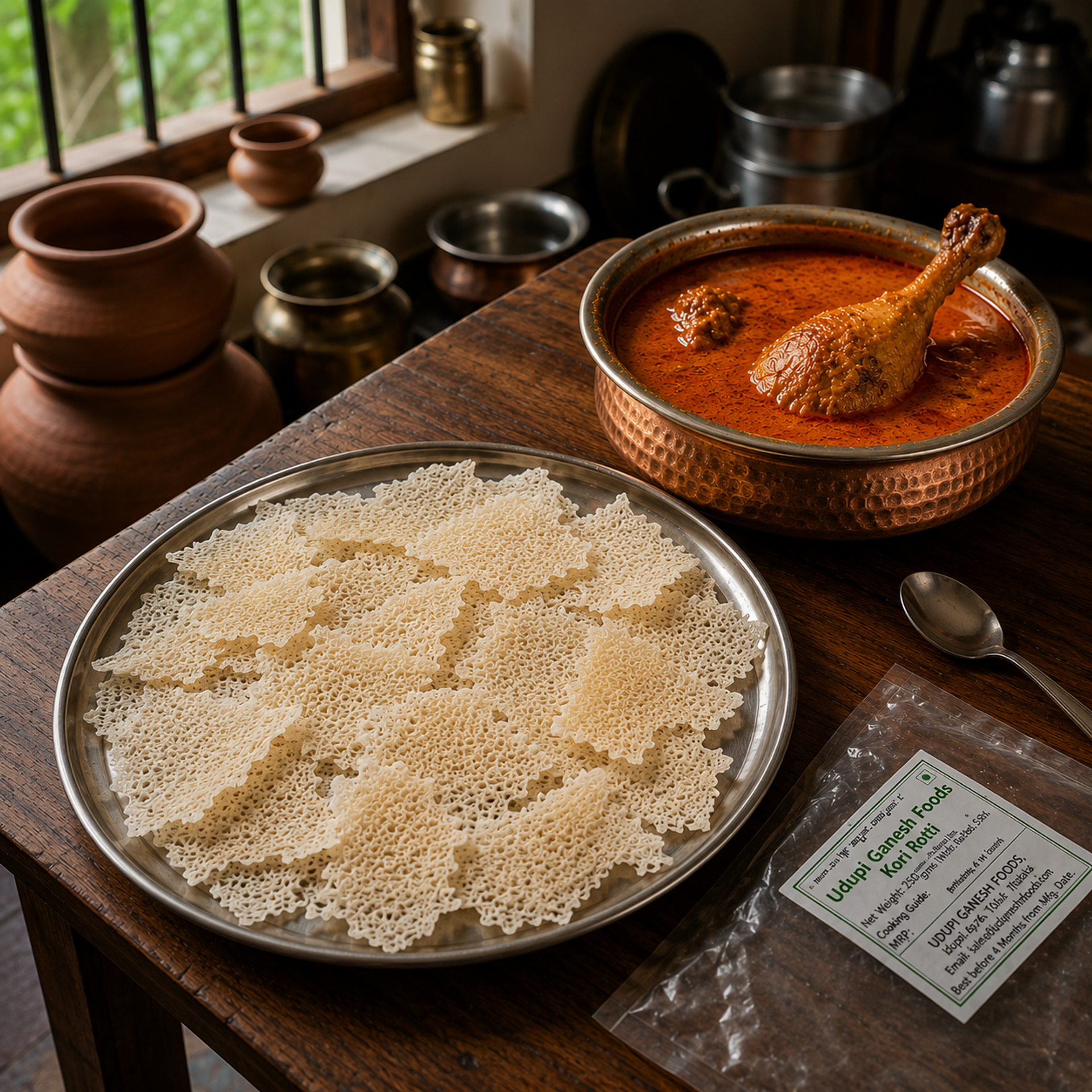
Kori Rotti is a thin, brittle rice wafer — the kind that snaps cleanly when you break it. Almost like edible paper, if edible paper had the faint, clean taste of rice and the kind of texture that disappears the moment it meets a curry.
It comes from Coastal Karnataka, specifically Mangalore, and it's been the backbone of one of the region's most beloved meals for generations. The name itself is Tulu — "Kori" means chicken, "Rotti" means the wafer. Named after what it's eaten with, not what it's made of.
No spices. No lentils. Just rice, water, and the skill of whoever's making it.
The process is simpler than you'd expect, but the margin for error is small.
A boiled rice batter is prepared and poured onto a large, hot tava — spread thin and even. As it cooks, small air pockets form across the surface. That's the sign you're watching it done right. The sheet is then cut into rectangles, lifted carefully off the tava, and left to cool.
That's it. No sun-drying, no oil, no additional processing. Straight from the tava, stacked, cooled, and packed.
The crispiness comes entirely from how thin the batter is spread and how well the tava is handled. This is why cheap Kori Rotti is always thicker — it's easier to work with, harder to mess up, and noticeably worse. A good Kori Rotti should be thin enough to see light through. Brittle enough to snap, not bend. The air pockets aren't decorative — they tell you the batter was spread right.
Our authentic Kori Rotti is sourced directly from Mangalore. You'll notice the difference.

Kori Rotti
ಕೋರಿ ರೊಟ್ಟಿ
Crispy Mangalorean rice wafers made for kori gassi — the iconic preparation that every Karavali household considers non-negotiable.
With Kori Gassi, ideally. That's the combination — Kori Rotti with a Mangalorean chicken curry built on a coconut-tomato base, Byadagi chillies, and cold-pressed coconut oil. Our Kori Gassi masala has the same traditional blend ready to use. This is what most Mangaloreans mean when they say "Kori Rotti" as a dish, not just an ingredient.
How you eat it is personal. Some people break the rotti into pieces, pour the hot curry over it, and let the whole thing sit for a minute — the rotti soaks up the curry and softens just slightly at the edges while staying slightly crisp underneath. Others prefer to keep the curry on the side and dip piece by piece, controlling exactly how much soak each bite gets.
Both ways work. Both are right. The texture somewhere between crispy and curry-soaked is the whole point.
Beyond chicken, Kori Rotti works with any Mangalorean-style non-veg curry — mutton, prawn, fish. The rotti doesn't compete with the curry, it absorbs it.
Yes — and this is an underrated combination.
The rotti itself is completely vegetarian (rice and water, nothing else), so the only question is what curry pairs well with it. From Coastal Karnataka tradition, two work particularly well.
Dal curry is the most common veg pairing. The richness of the dal absorbs into the rotti the same way a meat curry does — same eating method, same result.
Mangalore Basale curry — made with basale soppu (a variety of spinach common in Coastal Karnataka) — is the other. It's less well-known outside the region but genuinely good with the rotti. If you've never had Basale curry, it's worth trying.
For vegetarians who want to experience Kori Rotti properly, either of these works.
Kori Rotti doesn't really show up on weekday evenings. It's a Sunday dish. A gathering dish.
Sunday family lunches, home birthday parties, small get-togethers where someone decides it's worth the effort of making a proper Kori Gassi from scratch — that's when Kori Rotti appears. For Mangaloreans living in Bengaluru, far from home, it tends to show up when someone visits from the coast, or when someone simply decides this weekend needs to feel like home.
There's something about a pack of Kori Rotti on the kitchen counter and a curry on the stove that signals the rest of the day is going to be good.

SRR Kori Roti Masala
ಎಸ್ಆರ್ಆರ್ ಕೋರಿ ರೋಟಿ ಮಸಾಲ
The masala behind Karavali's most iconic dish — kori gassi the way it should taste
Kori Rotti stays good for three months in an unopened pack. Once you open it, the only thing that matters is keeping moisture out. An airtight container is the difference between crispy rotti and soft, disappointing wafers that have lost everything that makes them good.
Don't refrigerate it — the moisture will ruin the texture faster than leaving it out would. Keep it in a cool, dry place in a sealed container and it'll stay crisp for days after opening.
Our 280g pack is sealed for exactly this reason. The moment you open it, move what you're not using immediately into an airtight container.
No. Kori Rotti is a thin, crispy rice wafer made from boiled rice batter. Roti is a soft wheat flatbread. They share a similar-sounding name, but they're completely different in ingredients, texture, and how they're eaten.
"Kori" means chicken in Tulu, the language spoken in Coastal Karnataka. The dish is named after its classic pairing — Kori (chicken) curry with Rotti (rice wafers). The rotti itself contains no chicken.
Yes. The rotti is just rice and water. It pairs well with dal curry or Mangalore Basale (spinach) curry for a fully vegetarian meal.
Three months in an unopened pack. Once opened, store in an airtight container away from moisture. Don't refrigerate — it softens the rotti quickly.
Karavali Mangalore Store delivers Kori Rotti sourced directly from Mangalore across Bengaluru. Order at karavalimangalorestore.com.
Shop the Ingredients
Get everything you need from our store
Enjoyed this article?
Ready to taste authentic Mangalorean food?
Shop authentic ingredients and ready-to-eat products from the Karavali coast.